
Best Seats at an Ella Langley Concert, How to Choose by Venue Type
Best Seats at an Ella Langley Concert
- At an arena, lower level facing the stage beats the floor for most people.
- At an amphitheatre, the first rows behind the pit are the sweet spot.
- At a stadium, elevation beats proximity. The lower bowl sides win.
- Whether she headlines or plays direct support changes the answer entirely.
There is no single best seat at an Ella Langley concert, because she plays four completely different kinds of building.
A ticket that is excellent value at an amphitheatre is poor value at a stadium. Floor tickets are worth the premium at some venues and a waste of money at others. And the single biggest variable, which almost no seating guide mentions, is whether she is headlining for ninety minutes or playing a forty-five minute support set.
This guide works through each case. Start with the venue type, because everything else follows from it.
The Floor Is Not Automatically the Best Seat
Floor tickets cost the most at nearly every venue, and at roughly half of them they are the worst value on the map.
The reason is geometry. A concert floor is flat. Once you are more than a handful of rows back, the only thing guaranteeing your view is the height of whoever stands in front of you. Reserved seating is raked, which means the floor rises as it goes back and every row clears the one ahead.
Floor tickets are worth the premium in exactly two situations: when you intend to be in the first few rows and will arrive early enough to hold that position, or when the venue is small enough that no part of the floor is genuinely far away. Outside those two cases, a lower level seat costs less and shows you more.
Headline Show or Support Slot
This is the variable that changes everything, and almost nobody accounts for it when buying.
A headline set runs around ninety minutes and you will be in the building for four hours once support acts are counted. A direct support slot runs closer to forty-five minutes and sits early in the evening, when the room is only partly full.
Where the Sound Is Actually Best
The best sounding seat in almost any venue sits at or just behind the mixing desk, and it is rarely the most expensive.
This is not folklore. The engineer mixes the show from that position, so the sound is balanced for that spot by definition. Everywhere else in the room is a compromise the engineer is managing rather than optimising.
Front rows trade sound for proximity. Standing directly in front of a speaker stack, you hear a great deal of volume and comparatively little balance, and vocals in particular can get buried. If the performance matters more to you than the photographs, aim for the middle of the room rather than the front of it.
What Her Own 2026 Rooms Look Like
The four venue types are not abstract categories in her case. Ella Langley played all four across 2026, and the contrast between them makes the point better than any general rule.
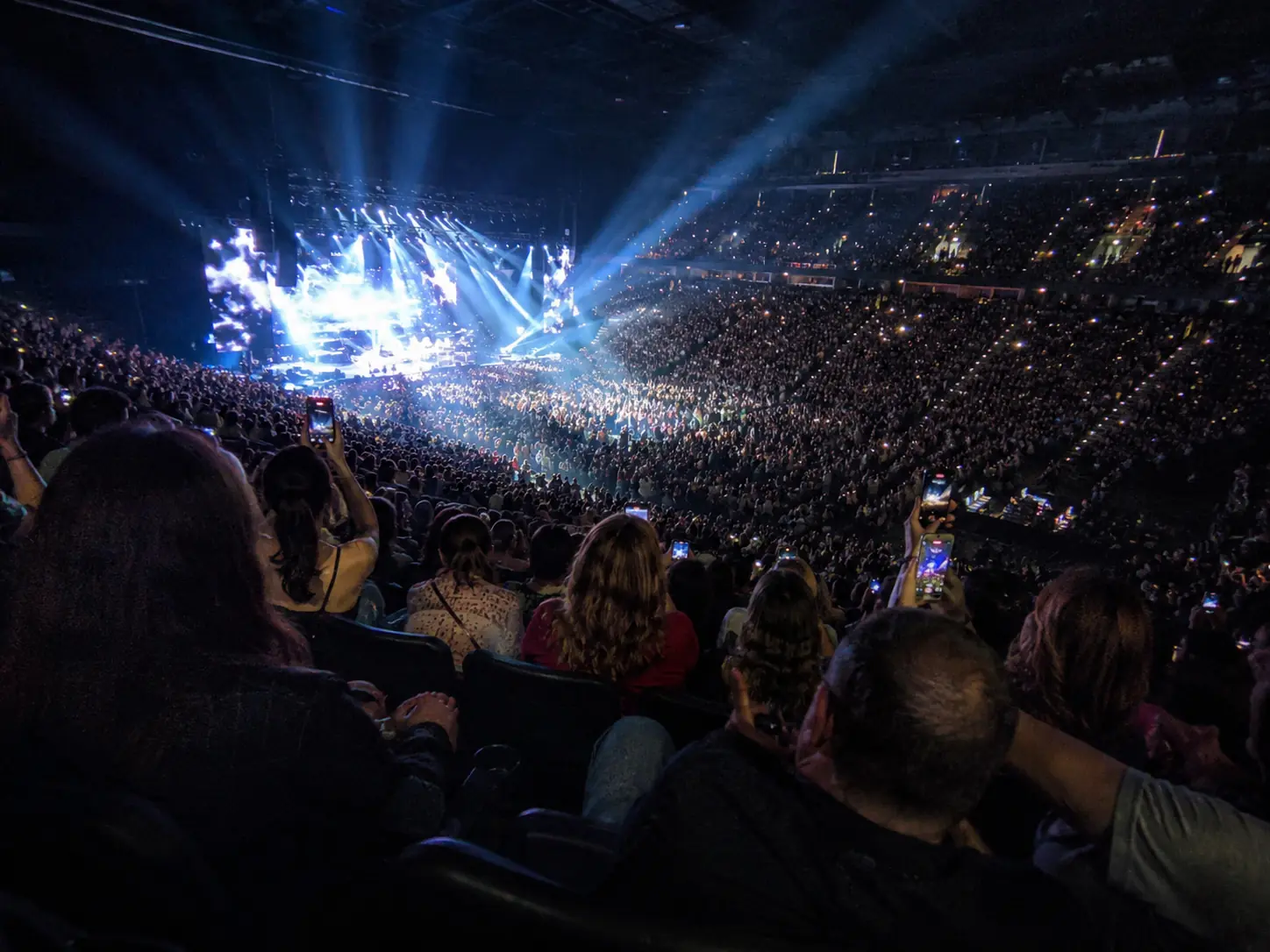
Grand Casino Arena in Saint Paul is the arena case at full scale. It holds up to 20,554 for a centre-stage concert across four levels, with a single steep lower bowl where every row clears the one in front. Floor tickets there cost the most and put you on flat ground.
Red Rocks Amphitheatre in Morrison, Colorado is the amphitheatre case in its purest form. The venue is a natural rock formation rather than a built structure, so sightlines are good almost everywhere and the real variables are temperature and the climb. The Greek Theatre in Los Angeles sits at the other end of the outdoor scale, a compact tree-lined bowl where the back rows are still close to the stage.
Neville Arena in Auburn shows why the headline question matters. Langley played two nights there, on her old university campus, which is a different room on night one and night two even though the seating chart is identical.
The stadium case came from her support run. Langley held direct support on nine Morgan Wallen Still The Problem Tour stadium dates, including Lincoln Financial Field in Philadelphia, which holds around 69,000 for concerts. At that scale, anyone past the first several rows on the floor is watching a screen, and a lower bowl side seat level with the soundboard beats a floor ticket comfortably.
One practical consequence runs through all of it. A ticket category that represents good value at the Greek Theatre can be poor value at Lincoln Financial Field, even at a similar price, because the buildings are doing completely different things with the same money.
Reading a Seating Chart Before You Buy
Seating charts are drawn to sell tickets, not to inform you, and there are three specific things worth checking that the chart will not tell you directly.

- Stage configuration. An end stage and a centre stage produce completely different maps. A section that is side-on for one is dead centre for the other.
- Production holds. Sections behind and beside the stage are often held back until the production is loaded in, then released. Those released seats are cheap, and sometimes genuinely fine.
- Obstructed view labelling. Venues label the obvious pillars. They do not label the delay towers, camera platforms and speaker stacks that the touring production brings with it.
The most reliable check takes two minutes: search the venue name alongside the section number and look at photographs taken from that seat at previous shows. Real photographs from real seats beat any chart.
How Much Extra Is Worth Paying
A useful rule: pay the premium for a better category, not for a better row within the same category.
Moving from upper level to lower level transforms the experience. Moving from row 20 to row 12 of the same section rarely does, and pricing frequently treats those two upgrades as comparable. The first is worth real money and the second usually is not.
The exception is the front section of any venue, where the difference between row 3 and row 10 genuinely is visible. If you are buying at that end of the market, rows matter. Everywhere else, categories matter and rows are noise.
Resale complicates the arithmetic further, because secondary prices move on demand rather than on sightlines. A section that the venue priced modestly can end up costing more than a better one simply because it sold out first.
The check that protects you takes seconds. Compare the resale price against the original category price before committing, and if the premium is large, look at what the next category up is going for. The better seat is sometimes the cheaper one.
Best Seats FAQ
Q: Are floor tickets always the best?
No. At arenas and stadiums, raked seating usually gives a better view for less money, because concert floors are flat.
Q: Where is the sound best?
At or just behind the mixing desk. The engineer balances the show from that exact position.
Q: Is the front row worth the money?
For proximity and photographs, yes. For sound quality, no. You are standing beside the speaker stacks rather than in front of them.
Q: What about seats behind the stage?
Sometimes released late and genuinely cheap. Check the stage configuration first, because it decides whether they see anything at all.
Q: Does it matter if she is supporting rather than headlining?
Enormously. A 45 minute support set rewards proximity, while a full headline show rewards comfort.
Q: Is an amphitheatre lawn ticket worth it?
Usually yes at a venue built into a slope. Check whether the lawn wraps wide, because the far edges lose the stage angle.
Venue by Venue Seating Guides
The principles above hold everywhere, but individual buildings have quirks worth knowing before you buy. Detailed seating breakdowns sit on the individual venue guides, including the Greek Theatre in Los Angeles and Grand Casino Arena in Saint Paul, each with an interactive map of that specific room.
For everything currently scheduled, the full list of upcoming dates is the place to start, and ticket information by show covers pricing as it stands.